Aaron Freeman 1745
Here’s the best evidence-based answer I can give today: our Y‑DNA strongly supports a Native American direct paternal line, and it also gives us time-stamped branching points—but it does not, by itself, print a tribe name on a specific man like Aaron Freeman. What it does do is narrow the historical possibilities, especially when we focus on the shared Freeman paternal ancestor who appears to sit in the mid‑1600s.
Here’s the best evidence-based answer I can give today: our Y‑DNA strongly supports a Native American direct paternal line, and it also gives us time-stamped branching points—but it does not, by itself, print a tribe name on a specific man like Aaron Freeman. What it does do is narrow the historical possibilities, especially when we focus on the shared Freeman paternal ancestor who appears to sit in the mid‑1600s.
The DNA we actually have
On the Y side, the Freeman cluster we’re discussing sits on a Haplogroup Q branch where one key split is around 1400 CE (Q‑BZ2738 branching from Q‑BZ2727), and a later split is around 1650 CE (downstream branches from Q‑BZ2738, e.g., Q‑BZ2728). These dates are estimates, but they’re useful because they bracket the exact era when the Southeast and Mid-Atlantic were being reshaped by confederation politics, colonial expansion, and Native communities consolidating, relocating, and sometimes being absorbed.
Why the 1400 MRCA is background
The ~1400 MRCA is an anchor that tells us the paternal line is already distinct by then, but it doesn’t help name a tribe for Aaron because “tribe” in the way we mean it (recorded political identity) becomes much more traceable closer to the 1600s—when Europeans are documenting alliances, towns, and conflicts. So for the “what tribe?” question, the actionable target is the shared Freeman paternal ancestor around the mid‑1650s, because that is the point where geography + records + history can start to intersect the genetics.
The mid‑1600s problem (and opportunity)
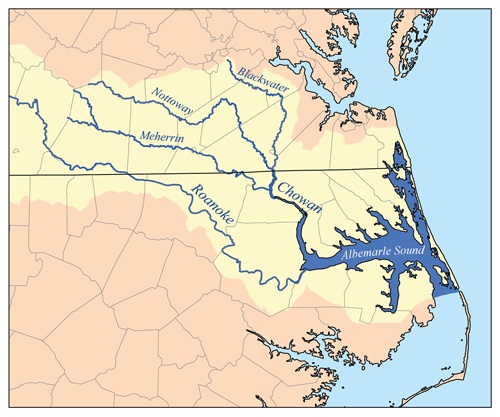
If many Freeman/Marsh/Dennis lines really converge on a shared paternal ancestor around the 1650s, we should expect that man’s life to sit in the middle of major regional instability. In Virginia’s Tidewater, Powhatan’s paramount chiefdom (Tsenacomoco) had been built by expansion through diplomacy and force, and by 1607 dozens of tribes/chiefdoms paid tribute to Powhatan—meaning identity and residence could shift via politics as much as by birth. In coastal NC/Albemarle, Native groups like the Chowanoc (Chowanoke) still had substantial presence into the mid‑1600s, then hit a sharp collision course with colonial settlement and war later in the century (including a peace treaty in 1663 and war in 1675–1677 in many summaries).
Two most plausible “tribe pathways” for Aaron’s paternal line
I’m going to frame these as testable hypotheses rather than declarations—because that’s how you keep this honest and solvable.
Pathway A: Coastal NC / Albemarle Sound (your Chowanoke-style hypothesis)
If the earliest Freeman cluster is truly coastal North Carolina, one strong option is that the 1650s shared ancestor came from an Algonquian community in the Albemarle/Chowan zone where the Chowanoc are documented as present and then forced through treaty/war/relocation dynamics later in the 1600s. This pathway fits the idea that the tribe identity could be “local” early on, and then the family shows up under an English surname as the colonial system hardens.
Pathway B: Northern VA / Powhatan sphere → migration south
If the “Freeman/Evans/Scott” line really points to northern Virginia, another plausible option is a man connected to the Powhatan-world political map (or its edges) who later ends up southward through marriage, adoption, refuge, or colonial-era relocation. Tsenacomoco wasn’t a static set of borders; it was a political umbrella whose reach changed over time, and that kind of structure is exactly how paternal lines can end up “belonging” to different named groups across generations.
What would actually answer the question
“Find that person and what tribe he was” is exactly right—but the “person” we can realistically hunt is the mid‑1650s Y‑MRCA, not the 1400 split. To name a tribe responsibly, we need at least one hard anchor that ties a Freeman male (or a close Y match) to a specific community: a documented location at a specific date; an association with a known town/river; a treaty/reservation context; or a cluster of Y matches whose earliest paper trails land in the same Native community
What would actually answer the question
“Find that person and what tribe he was” is exactly right—but the “person” we can realistically hunt is the mid‑1650s Y‑MRCA, not the 1400 split. To name a tribe responsibly, we need at least one hard anchor that ties a Freeman male (or a close Y match) to a specific community: a documented location at a specific date; an association with a known town/river; a treaty/reservation context; or a cluster of Y matches whose earliest paper trails land in the same Native community


Thank you for the detailed information about the Freeman line(s). I’m truly grateful for everyone’s efforts—especially the focus on using DNA. Thank you to all who are collaborating and participating to help us put the puzzle together and sort out our Freemans (and affiliated).
ReplyDeleteWith all the collaboration, I see it revealing, it is amazing and fun to watch this all come together.
ReplyDelete